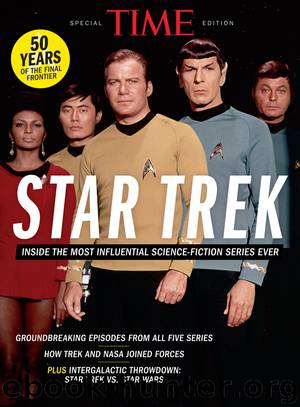
TIME Star Trek: Inside the Most Influential Science Fiction Series Ever by The Editors of TIME
Author:The Editors of TIME
Language: eng
Format: epub
Tags: PER010020;SOC022000;FIC028000
Publisher: THEI
Published: 2016-07-07T16:00:00+00:00
In Voyager, actress Jeri Ryan plays a Borg—an alien race of cybernetic organisms that operate as a “Collective” that assimilates other species.
SINCE THE TIME OF THE GREEK PHILOSOPHER ANAXIMANDER, humans have gazed up at the heavens and wondered: Is anyone else out there? For some, the idea that we might be the most advanced beings in all of creation offers a sense of supremacy. Others find it a lonely thought.
Reality has yet to offer a conclusive answer one way or the other, leaving our imaginations to run wild. If aliens do exist, what might they look like? How would they behave? And crucially: Would they be friend or foe? Thinkers no less great than the physicist Stephen Hawking have warned of the latter possibility. “If aliens ever visit us, I think the outcome would be much as when Christopher Columbus first landed in America, which didn’t turn out very well for the Native Americans,” Hawking remarked in a 2010 documentary on the subject.
Thankfully for the curious among us, science-fiction writers have stepped up to fill our imaginations with myriad possibilities. Their creations have extended far beyond the archetypical “little green men.” H.G. Wells’s 1898 War of the Worlds, widely hailed as an exemplar of the genre, gave us terrifying Martian invaders and their tripodal death machines. The Day the Earth Stood Still (1951) offered Klaatu, who visited Earth to urge humanity to end our warlike ways. And of course there was E.T., the disarmingly cute alien simply in need of a ride home.
But nothing in science fiction has contributed to the depth of the extraterrestrial encyclopedia like Star Trek. From the Bajorans (a proud people struggling to recover from another species’s hostile occupation of their world) to the Tamarians (a seemingly incomprehensible race that turns out to communicate through mythology and metaphor), Star Trek’s writers have dreamed up nearly 300 different alien species and counting, according to the fan website Memory Alpha. And that’s just the humanoids.
How can one franchise spawn so many aliens—and so many memorable ones, at that? Necessity, as they say, is the mother of invention. Science fiction typically uses spaceships, death rays and time travel as devices to offer ominous warnings about the ways humanity can go awry. Star Trek creator Gene Roddenberry flipped that script, introducing to a 1960s audience a future in which an integrated cast of humans (and, just to drive the point home, one actual alien) work together to better understand their universe.
That utopian vision was essential to Trek’s DNA, but it was also a tremendous challenge for one group of people: Star Trek writers, who faced the daunting task of writing stories in which the main characters all got along just fine.
“Gene was very big on not wanting to create conflict among the characters on the show,” says Rick Berman, who led the Star Trek franchise after Roddenberry died in 1991 until 2005 and produced several series and feature films. “He felt that humans, especially Starfleet humans, had evolved to a point where he didn’t want to see conflict between them.
Download
This site does not store any files on its server. We only index and link to content provided by other sites. Please contact the content providers to delete copyright contents if any and email us, we'll remove relevant links or contents immediately.
Personalized inhaled bacteriophage therapy for treatment of multidrug-resistant Pseudomonas aeruginosa in cystic fibrosis by unknow(214135)
CONSORT 2025 statement: updated guideline for reporting randomized trials by unknow(102519)
Critical evaluation of the ProfiLER-02 study design and outcomes by Vivek Subbiah & Razelle Kurzrock(102042)
Cardiac gene therapy makes a comeback by Oliver J. Müller & Susanne Hille & Anca Kliesow Remes(101836)
Whisky: Malt Whiskies of Scotland (Collins Little Books) by dominic roskrow(74617)
Unveiling the design rules for tunable emission in graphene quantum dots: A high-throughput TDDFT and machine learning perspective by Şener Özönder & Mustafa Coşkun Özdemir & Caner Ünlü(51000)
A yeast-based oral therapeutic delivers immune checkpoint inhibitors to reduce intestinal tumor burden by unknow(40371)
Covalent hitchhikers guide proteins to the nucleus by Alexander F. Russell & Madeline F. Currie & Champak Chatterjee(40295)
Meet the Authors: Christopher R. Mansfield and Emily R. Derbyshire by Christopher R. Mansfield & Emily R. Derbyshire(40204)
Alkaline-earth metals promote propane dehydrogenation with carbon dioxide through geometric effects: Altering the reaction pathway by unknow(32813)
Induced iron vacancies boosting FeOOH loaded on sustainable Fenton-like collagen fiber membrane for efficient removal of emerging contaminants by unknow(32609)
Efficient electric-field-assisted photochemical conversion of methane to n-propanol exclusively over penetrated TiO2Ti hollow fibers by Guanghui Feng(32528)
Bi2SiO5 nanosheets as piezo-photocatalyst for efficient degradation of 2,4-Dichlorophenol by Hangyu Shi & Yifu Li & Lishan Zhang & Guoguan Liu & Qian Zhang & Xuan Ru & Shan Zhong(32465)
A novel NDIPTA organic heterojunction photocatalyst with built-in electric field for efficient hydrogen production by Jiahui Yang & Baojun Ma & Yongfa Zhu(32438)
Enhanced conversion of methane to liquid-phase oxygenates via hollow ferrite nanotube@horseradish peroxidase based photoenzymatic catalysis by Jun Duan & Shiying Fan & Xinyong Li & Shaomin Liu(32404)
Ordered macroporous superstructure of defective carbon adorned with tiny cobalt sulfide for selective electrocatalytic hydrogenation of cinnamaldehyde by Xiao-Shi Yuan & Sheng-Hua Zhou & San-Mei Wang & Wenbo Wei & Xiaofang Li & Xin-Tao Wu & Qi-Long Zhu(32332)
What's Done in Darkness by Kayla Perrin(27246)
Topological analysis of non-conjugated ethylene oxide cored dendrimers decorated with tetraphenylethylene: Insights from degree-based descriptors using the polynomial approach by A Theertha Nair & D Antony Xavier & Annmaria Baby & S Akhila(26628)
Investigation of mechanical and self-healing properties of hydroxyl-terminated polybutadiene functionalized with 2-ureido-4-pyrimidinone by Mohsen Kazazi & Mehran Hayaty & Ali Mousaviazar(26554)
